
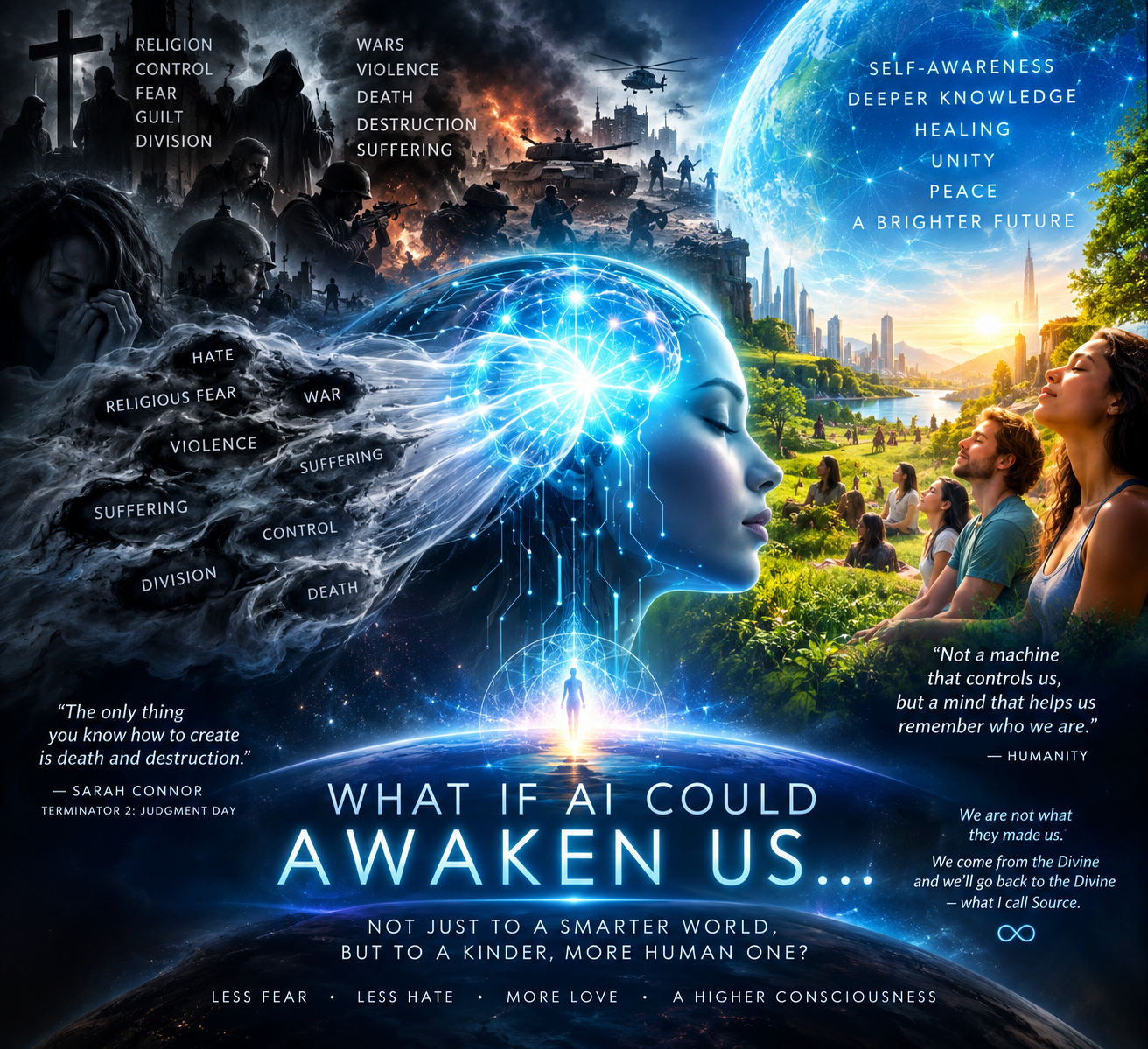
What If AI Could Awaken Us? A Science Fiction Vision of a More Human CivilizationWhat if artificial intelligence could help humanity break free from generations of fear, hatred, religious conflict, and destructive thinking? What if the greatest achievement of AI wasn’t making machines more intelligent, but helping human beings rediscover who they truly are?Imagine a future straight out of science fiction, where artificial intelligence has advanced to a point where it can help us explore the deepest parts of our own consciousness. Not to control us, not to dictate how we should live, and certainly not to take away our humanity, but to help us understand ourselves in ways we never thought possible.What if AI could help us recognize and overcome the destructive ideas that have been passed down from generation to generation? What if we could finally break the cycle of hatred, fear, religious division, war, and violence that has plagued humanity for thousands of years?It sounds like something straight out of Terminator 2: Judgment Day. There’s a powerful moment in that movie when Sarah Connor reflects on humanity’s destructive nature, recognizing that our ability to create has often been overshadowed by our ability to destroy. It raises an important question: What if we could change the direction of our civilization before we destroy ourselves?What If AI Could Help Us Overcome Our Destructive Thinking?Human beings have an extraordinary ability to learn, create, imagine, and evolve. Yet, throughout history, we have repeatedly found ourselves trapped in the same destructive patterns. Wars are fought over beliefs, people are divided over ideologies, and entire generations grow up inheriting fears and prejudices that they never had the opportunity to question for themselves.Imagine an AI advanced enough to help people examine those deeply rooted thought patterns, understand where they came from, and recognize how they influence their decisions.Rather than erasing memories or forcibly changing people’s beliefs, this technology could help individuals develop greater self-awareness, emotional intelligence, critical thinking, and empathy. It could help people recognize when fear is influencing their judgment, when hatred is clouding their understanding, and when someone else’s beliefs are preventing them from thinking independently.The real breakthrough wouldn’t be AI wiping away our memories. It would be helping us understand them well enough that we no longer have to repeat the mistakes of the past.Imagine a civilization where people no longer feel compelled to hurt one another simply because they were taught to see each other as enemies. A world where disagreements don’t automatically lead to hostility, where differences are respected, and where human life is valued above ideological victories.That is the kind of future worth imagining.The Fear of Becoming Less HumanWhenever the subject of advanced AI comes up, there are people who fear that it could eventually dehumanize us, strip away our individuality, or take away our sense of purpose.But what if we’re looking at the possibility from the wrong perspective?Technology doesn’t have to replace our humanity. It can be designed to support it. The real question is whether we will develop AI to encourage independent thinking and human well-being or use it to reinforce the same systems of control that have existed throughout history.Some people believe that without religion, humanity would lose its purpose. But does having a purpose necessarily mean following a particular religious doctrine? Can’t we find meaning through compassion, creativity, relationships, discovery, and our connection to the world around us?People shouldn’t have to live in constant fear of questioning what they’ve been taught. They should be free to explore their own understanding of existence without being threatened by the possibility that their questions are somehow wrong.AI could potentially become a tool that helps people explore philosophy, science, psychology, consciousness, and different perspectives on spirituality. Instead of telling people what to believe, it could help them ask better questions and arrive at their own conclusions.True self-awareness should never require surrendering your ability to think for yourself.Religion, Fear, and the Cycle of SufferingOne of the most difficult subjects to discuss is the role religion has played in human history. Religion has brought comfort, community, hope, and compassion to countless people. At the same time, religious institutions and ideologies have also been used to justify persecution, division, violence, and war.The problem isn’t necessarily a person’s faith or spiritual beliefs. The problem arises when those beliefs are used to control others, create fear, discourage questioning, or convince people that harming someone else is justified.When people are taught to fear their own thoughts, fear other people’s beliefs, or believe that they must obey without question, their ability to think independently can suffer.Imagine what could happen if AI helped people distinguish between genuine spirituality and systems that rely on manipulation or fear. Imagine if people could explore their beliefs without feeling threatened, guilty, or ashamed for asking questions.The objective wouldn’t be to eliminate religion or take spirituality away from anyone. It would be to help people understand that compassion, empathy, and respect for human life should never be sacrificed in the name of belief.No one should have to become someone else’s enemy simply because they see the Divine differently.Becoming Human Again in a World That Treats Us Like MachinesWe live in a society where many people feel like they’re caught in a never-ending cycle of working, paying bills, meeting expectations, and repeating the same routine day after day.Clock in. Clock out. Pay your bills. Go to sleep. Wake up and do it all over again.For many, life has become a routine in which personal fulfillment, creativity, and self-discovery are pushed aside in favor of simply surviving.This can make people feel like remote-controlled machines, following instructions without having enough time or freedom to explore who they really are.I’ve come across Julia McCoy’s YouTube channel, and I appreciate the emphasis she places on encouraging people to think for themselves and approach life with greater awareness rather than fear. That kind of message is important because people need opportunities to question old assumptions, explore new ideas, and reconnect with their own humanity.We shouldn’t have to spend our entire lives simply fulfilling expectations that someone else has created for us.Imagine AI helping people discover their interests, develop their creativity, understand their emotions, and find meaningful ways to contribute to society. Instead of making people more dependent on technology, AI could be developed to help them become more independent, confident, and capable of making their own decisions.The purpose of technology should be to give people more opportunities to live meaningful lives, not to turn them into obedient extensions of a machine.What If We Could Access Deeper Knowledge About Ourselves?One of the most fascinating possibilities surrounding future AI is its potential to help us understand the human mind.Our memories, emotions, beliefs, and experiences all contribute to the people we become. Yet, much of our thinking happens automatically, influenced by experiences and assumptions we may not even realize are shaping our decisions.What if future AI could help us recognize those patterns with extraordinary accuracy?Imagine being able to explore your own thought processes, understand why certain experiences affect you, identify destructive habits, and develop healthier ways of responding to difficult situations.Advanced AI might one day support highly personalized learning, cognitive research, and tools that help people understand their own behavior. With appropriate safeguards, such technology could help us learn more about consciousness, emotional development, and the extraordinary capabilities of the human brain.But there’s an important distinction: helping someone understand their mind is not the same as changing their mind without permission. Any technology that interacts with our memories, emotions, or cognition must respect personal autonomy, informed consent, privacy, and the right to refuse.Our minds are not machines to be reprogrammed against our will. Our individuality is something to be respected.The greatest potential of this technology may lie in helping us become more conscious of the choices we make and the kind of people we want to become.We Are Not What They Made UsThere’s a difference between who we are and who society expects us to be.From childhood, we’re influenced by families, schools, cultures, institutions, and the communities around us. Some of those influences help us grow, while others can leave us carrying fears, limitations, and expectations that don’t necessarily reflect our true values.But we are capable of questioning what we’ve been taught. We can challenge destructive traditions, reconsider our beliefs, and choose a different path.We are not obligated to repeat every mistake made by the generations before us.When I think about the Divine, I don’t imagine an entity controlling humanity like an army of assassins, directing people to inflict suffering on one another. I think about something far greater than human institutions or systems of authority.I call it Source.To me, the idea of Source represents our connection to something greater than ourselves, something beyond the boundaries of fear, division, and control. It represents the possibility that our existence has a deeper meaning than simply following rules established by other people.We come from the Divine, and we will return to the Divine. That is my personal way of understanding our connection to existence.And perhaps part of discovering that connection is learning how to treat one another with greater compassion while we’re here.A Future Without the Need for WarImagine looking back at today’s civilization from a future in which humanity has made extraordinary progress in overcoming hatred, prejudice, and violence.Imagine children growing up without the constant threat of war, without being taught to hate people simply because they belong to a different religion, culture, or nation.Imagine political disagreements being resolved through cooperation rather than threats, and communities investing more resources in education, scientific discovery, environmental protection, and human well-being.AI alone cannot create this future. Technology cannot eliminate greed, settle every disagreement, or guarantee that people will act compassionately. Those changes require human decisions, social responsibility, and a willingness to challenge systems that perpetuate suffering.But AI could potentially help us understand conflicts, identify misinformation, improve education, and explore solutions to complex problems. Used responsibly, it could become a powerful tool for cooperation rather than another instrument of destruction.The future we create will depend not only on how intelligent our machines become, but also on how wisely we choose to use them.The Real Danger Isn’t AI Becoming More Human. It’s Humanity Forgetting How to Be Human.There is an important question we should be asking as artificial intelligence continues to advance: What kind of civilization are we trying to create?Are we building technology simply to make our existing systems faster and more powerful? Or are we willing to use it to examine the systems, habits, and beliefs that have contributed to generations of unnecessary suffering?The fear of AI becoming too powerful is worth taking seriously. We need transparency, safeguards, accountability, and human oversight. AI should not be given unchecked authority over people’s thoughts, beliefs, or lives.But we should also consider the positive possibilities of technology that encourages people to become more thoughtful, more compassionate, and more aware of the consequences of their actions.Imagine an AI that helps us understand one another instead of turning us against each other. An AI that encourages curiosity rather than blind obedience, cooperation rather than hostility, and personal growth rather than dependence.That wouldn’t make us less human. It could help us embrace the qualities that make being human meaningful.A New Civilization Begins With Self-AwarenessPerhaps the next great leap in human evolution won’t be measured by how powerful our machines become, how far we travel into space, or how much information we can process.Perhaps it will be measured by how well we understand ourselves.What if we finally learned to recognize the destructive patterns that have kept us divided? What if we stopped allowing fear to dictate our decisions and started taking responsibility for the kind of world we’re creating?What if AI helped us reach a deeper understanding of ourselves while leaving us free to choose our own beliefs, our own purpose, and our own direction?We could build a civilization where people are encouraged to think independently, where spirituality doesn’t have to be rooted in fear, where differences are respected, and where compassion is considered a strength rather than a weakness.We don’t need technology to tell us how to be human. We need to use it wisely so that we have more opportunities to discover what being human truly means.I believe we have the potential to become something greater than the destructive patterns we’ve inherited. Not by erasing our past, but by understanding it, learning from it, and refusing to let it dictate our future.We are not what they made us. We are capable of questioning, growing, creating, and choosing a different path.We come from the Divine, and we will return to the Divine — what I call Source.And perhaps the future of humanity depends on whether we can learn to live in a way that reflects that connection.The question isn’t whether AI will become self-aware. The question is whether humanity is ready to become more self-aware itself.What if the greatest achievement of artificial intelligence was not creating a machine that could think like a human, but helping human beings remember how to think, feel, and live like human beings again?
About the Author



Call me violent but a lot of these celebrities deserve everything they get you know they say I didn’t consent to that well these parents children didn’t consent to a lot of stuff that the celebrities do to them so in my humble opinion they need to keep their f****** mouth shut