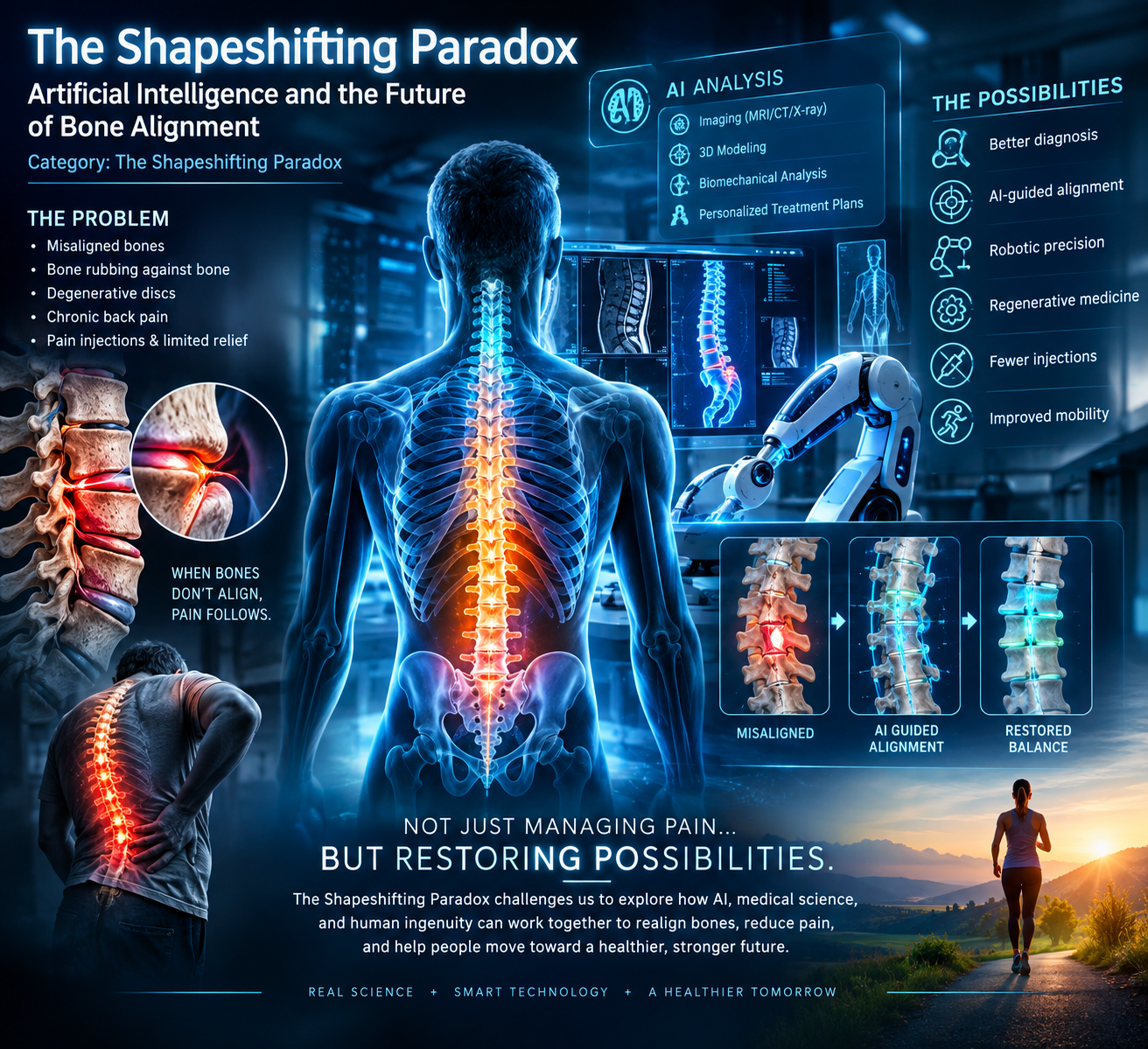
The Shapeshifting Paradox: Artificial Intelligence and the Future of Bone Alignment

The Shapeshifting Paradox: Artificial Intelligence and the Future of Bone AlignmentCategory: The Shapeshifting ParadoxWhen Artificial Intelligence Meets the Human SkeletonWhat if we could use artificial intelligence to help the human body correct structural problems that cause chronic pain? Imagine a future in which AI-assisted medical technology could identify misaligned bones, detect abnormal pressure on the spine, and help doctors develop precise ways to restore proper skeletal function without relying solely on pain medication, injections, or invasive surgery.The human skeleton is an extraordinary biological structure. It supports our weight, protects our organs, and allows us to move. However, as we age, experience injuries, or develop degenerative conditions, the structures that support our bones can deteriorate, sometimes resulting in chronic pain, restricted movement, and reduced quality of life.One of the most troubling examples is what is commonly described as bone rubbing against bone. This can occur when protective cartilage wears away in a joint. In the spine, pain may also come from damaged discs, arthritic facet joints, narrowed spaces around nerves, or other structural changes.What if AI could help us understand these problems at a much deeper level and assist medical professionals in finding ways to relieve the pressure, improve stability, and restore movement?This is where the Shapeshifting Paradox enters the discussion: the possibility of using intelligent technology to help the human body adapt, repair, and function differently, while respecting the biological limits of the skeletal system.Understanding the Science Behind Bone AlignmentTo understand how AI might help correct skeletal problems, we first need to understand the biological mechanics of the human spine.The spine consists of individual vertebrae separated by intervertebral discs, which act as shock absorbers. Small joints called facet joints help guide spinal movement, while ligaments, muscles, and connective tissues provide stability.When these structures begin to deteriorate, the spine can lose some of its normal function. Degenerative disc disease, osteoarthritis, spinal stenosis, and certain forms of spinal deformity can contribute to chronic pain.In some joints, cartilage wears away until the surfaces of the bones come into closer contact. This is commonly called bone-on-bone arthritis. In the spine, however, pain can also originate from irritated nerves, inflammation, muscle dysfunction, or changes in the discs and surrounding joints.This distinction is important because not every painful spine is misaligned. Simply moving a bone into a different position would not necessarily restore damaged cartilage or eliminate the source of pain.The scientific challenge, therefore, is not just to realign bones. It is to identify what is causing the pain and determine whether the underlying problem can be safely corrected.Artificial Intelligence as a Medical Alignment SystemImagine a medical system that combines artificial intelligence, advanced imaging, robotics, and biomechanical analysis to create a detailed model of a patient’s spine.AI could analyze MRI scans, CT scans, and X-rays to identify changes in vertebral positioning, disc height, spinal curvature, joint degeneration, and potential nerve compression. It could compare these findings with a patient’s symptoms, medical history, movement patterns, and other clinical information.This is not entirely theoretical. AI is already being researched and used in spinal imaging to help measure alignment, analyze anatomical structures, support surgical planning, and predict certain treatment outcomes.A future system could potentially create a patient-specific biomechanical model, sometimes called a digital twin. This would be a computer-based representation of a person’s anatomy and movement that doctors could use to simulate possible treatments.For example, the system could examine how a change in spinal posture might affect pressure on particular joints, how a damaged disc might influence spinal stability, or whether a proposed procedure could increase stress on nearby vertebrae.The goal would be to give medical professionals a more accurate understanding of the problem before deciding how to treat it.Could AI Actually Move Bones Back Into Alignment?This is where the idea becomes particularly interesting.Imagine a future medical implant or externally controlled robotic system that could assist with correcting certain forms of skeletal misalignment. AI could potentially analyze the patient’s anatomy, calculate carefully controlled mechanical forces, and monitor how the body responds to a treatment.AI itself cannot physically move a bone. A mechanical device, surgical procedure, or biological process would be needed to produce a physical change.One possible direction for future research would be AI-guided, patient-specific implants or adjustable orthopedic devices. These could potentially help maintain or gradually correct selected structural abnormalities under specialist supervision.For example, in carefully selected cases of spinal deformity, surgeons already use screws, rods, and other implants to correct and stabilize the spine. Robotic guidance and AI-assisted planning could help improve the precision of certain procedures.In the future, researchers might investigate whether intelligent, adjustable systems could make some corrective treatments more personalized, with continuous monitoring of forces and structural changes.However, applying force to a damaged spine can cause nerve injury, fractures, instability, or worsening pain if the treatment is inappropriate. There is currently no established AI implant that independently realigns degenerative spinal bones and restores worn cartilage.The possibility of AI-controlled skeletal correction remains a research direction, not an established treatment.Regenerative Medicine: Repairing What Has DeterioratedBone alignment is only one part of the problem. What if future medical science could also repair some of the biological structures that have deteriorated?Regenerative medicine is an area of research that explores ways to repair or replace damaged tissues. Scientists are investigating tissue engineering, biomaterials, cell-based therapies, and biological signals that may help repair cartilage and other musculoskeletal tissues.AI could potentially accelerate aspects of this research by analyzing cellular behavior, helping researchers identify promising biomaterials, modeling tissue responses, and assisting in the development of personalized treatment approaches.For people with cartilage deterioration, the long-term ambition would be to find ways to preserve or restore the cushioning that protects the ends of bones.Spinal discs present an additional challenge because they have a complex structure and limited capacity for natural repair. Researchers are investigating biological and tissue-engineering approaches, but reliably restoring a severely degenerated disc remains difficult.Although these technologies hold promise, regenerative treatments are not yet a proven way to rebuild severely worn spinal cartilage or reverse advanced degenerative disease.Combining regenerative medicine with AI-guided biomechanical assessment could become an important area of future research, but clinical trials would need to demonstrate safety, durability, and meaningful improvements for patients.Reducing the Need for Pain InjectionsFor many people with chronic back pain, treatment can involve physical therapy, medication, epidural steroid injections, or other procedures, depending on the underlying condition.Injections can help reduce inflammation and relieve symptoms in certain patients, but they do not necessarily correct structural problems or repair damaged tissue.AI could potentially help doctors identify which patients are most likely to benefit from particular treatments. By examining imaging results, symptoms, physical function, and treatment history, an AI-assisted system could support more individualized clinical decisions.AI-supported exercise platforms and digital rehabilitation tools are also being studied for chronic lower back pain. Research has identified promising results from some digital interventions, although the evidence remains limited and varies in quality.In the future, AI-assisted monitoring could also help patients and clinicians track progress during rehabilitation, recognize changes in movement, and adjust treatment plans when appropriate.The objective would not necessarily be to eliminate injections altogether. Instead, it would be to improve treatment selection, reduce unnecessary procedures, and help people achieve longer-lasting relief whenever possible.The Role of Robotics and Intelligent ImplantsOne of the most promising areas connecting AI and skeletal medicine is robotic-assisted surgery.Robotic systems can help surgeons plan and execute specific procedures with detailed imaging and navigational guidance. AI may further assist by processing anatomical information, predicting potential complications, and supporting surgical decision-making.Some researchers are also exploring smart orthopedic implants containing sensors that can measure forces, movement, or other physical conditions.A potential future development could combine these technologies into a system that monitors how a patient’s spine responds after treatment. Such a system might alert a clinician to changes in loading or stability that warrant further assessment.However, a smart implant that measures a physical condition is not the same as an implant that can safely adjust the position of a bone. Any future system that actively changes mechanical forces would require extensive safety testing, safeguards, and medical supervision.The purpose of such research would be to make skeletal treatment more precise and responsive to the individual patient rather than applying the same approach to everyone.The Shapeshifting Paradox: Could Technology Help the Body Adapt?The Shapeshifting Paradox explores an intriguing question: could technology help the human body change the way it functions without changing what makes it biologically human?The human skeleton is not a static structure. Bone tissue is continually remodeled through the activity of cells that break down old bone and form new bone. Muscles adapt to physical demands, and the nervous system continually adjusts movement in response to sensory information.This natural adaptability is one reason rehabilitation can be effective. Carefully designed exercise can improve muscle strength, coordination, joint function, and the support surrounding the spine.AI could potentially help medical professionals understand these biological responses in greater detail. By analyzing movement data, muscle activity, imaging, and patient progress, future systems might help personalize rehabilitation and identify when a treatment needs to be adjusted.Rather than forcing the body into an artificial position, the longer-term ambition could be to help restore more effective movement and distribute mechanical loads more appropriately.This is where the paradox emerges: technology could potentially help the body adapt to structural damage while working within the body’s own biological capabilities.The Challenges Medical Science Must OvercomeDespite the possibilities, there are substantial scientific and medical challenges.- Accurate diagnosis: Imaging abnormalities do not always explain a patient’s pain. AI must support a complete clinical assessment rather than simply identify unusual bone positions.- Mechanical safety: The spine protects the spinal cord and nerve roots. Any system that changes its alignment or applies force must avoid causing injury or instability.- Biological limitations: AI cannot independently regenerate missing cartilage, reverse advanced degeneration, or guarantee that damaged tissues will heal.- Long-term effectiveness: New devices and treatments must be tested to establish whether they provide lasting benefits rather than temporary symptom relief.- Medical oversight: AI should support qualified medical professionals, with clear accountability, patient consent, and regulatory review.AI in spine care is advancing, but much of the evidence remains preliminary, and many proposed applications still require further clinical validation.A Future Where AI Helps Restore MobilityImagine a future in which a person experiencing years of chronic back pain can undergo a comprehensive AI-assisted evaluation that combines detailed spinal imaging, movement analysis, and individualized biomechanical modeling.The system could help doctors identify the structures most likely to be responsible for the pain, simulate potential treatment approaches, and monitor the patient’s response to rehabilitation or surgery.In some cases, this might mean a personalized exercise program. In others, it might mean an existing medical intervention performed with improved planning and precision. Future advances in regenerative medicine and intelligent implants may eventually expand the available options.The ultimate goal would be to reduce unnecessary suffering, improve mobility, and help people regain independence.For people who have spent years relying on pain injections or other treatments that provide only temporary relief, advances in AI-assisted medicine could offer new avenues for investigation.The key will be distinguishing what technology can already accomplish from what remains a scientific ambition.Conclusion: The Next Evolution of Bone AlignmentThe combination of artificial intelligence, biomechanics, medical robotics, and regenerative medicine could reshape how we understand and treat skeletal disorders.AI is already contributing to spinal imaging, alignment measurements, treatment planning, and research into personalized care. What remains uncertain is whether future technology will be able to actively correct certain bone alignment problems through intelligent, adaptive systems or combine structural correction with reliable tissue regeneration.The idea of using AI to help the body restore proper skeletal function is scientifically compelling, but it requires careful research, clinical trials, and medical oversight before it can become a safe and effective treatment.The Shapeshifting Paradox asks us to consider what might become possible when biological systems and intelligent technology work together—not to replace the body’s natural processes, but to understand them, support them, and potentially help people move beyond the physical limitations imposed by injury and degeneration.Perhaps the future of skeletal medicine will not be defined by technology simply holding the body together, but by helping medical science discover more precise ways to restore the movement, stability, and quality of life that people have lost.Medical note: This article explores emerging scientific concepts and future possibilities. AI-assisted imaging and treatment planning are developing fields, but AI-controlled bone realignment and AI-driven restoration of severely damaged spinal cartilage are not established clinical treatments. Anyone experiencing persistent or worsening back pain should seek an assessment from a qualified healthcare professional.Research references- Artificial Intelligence in Spine Care: A Scoping Review of Treatment Applications (2026)- Can Artificial Intelligence in Spine Imaging Affect Current Practice? (2025)- Digital Twins and Multimodal Artificial Intelligence in Spine Care (2026)

BRUCE FICTION
Sabrina carpenter BLOWS CUM BUBBLES OUT HER MOUTH
